

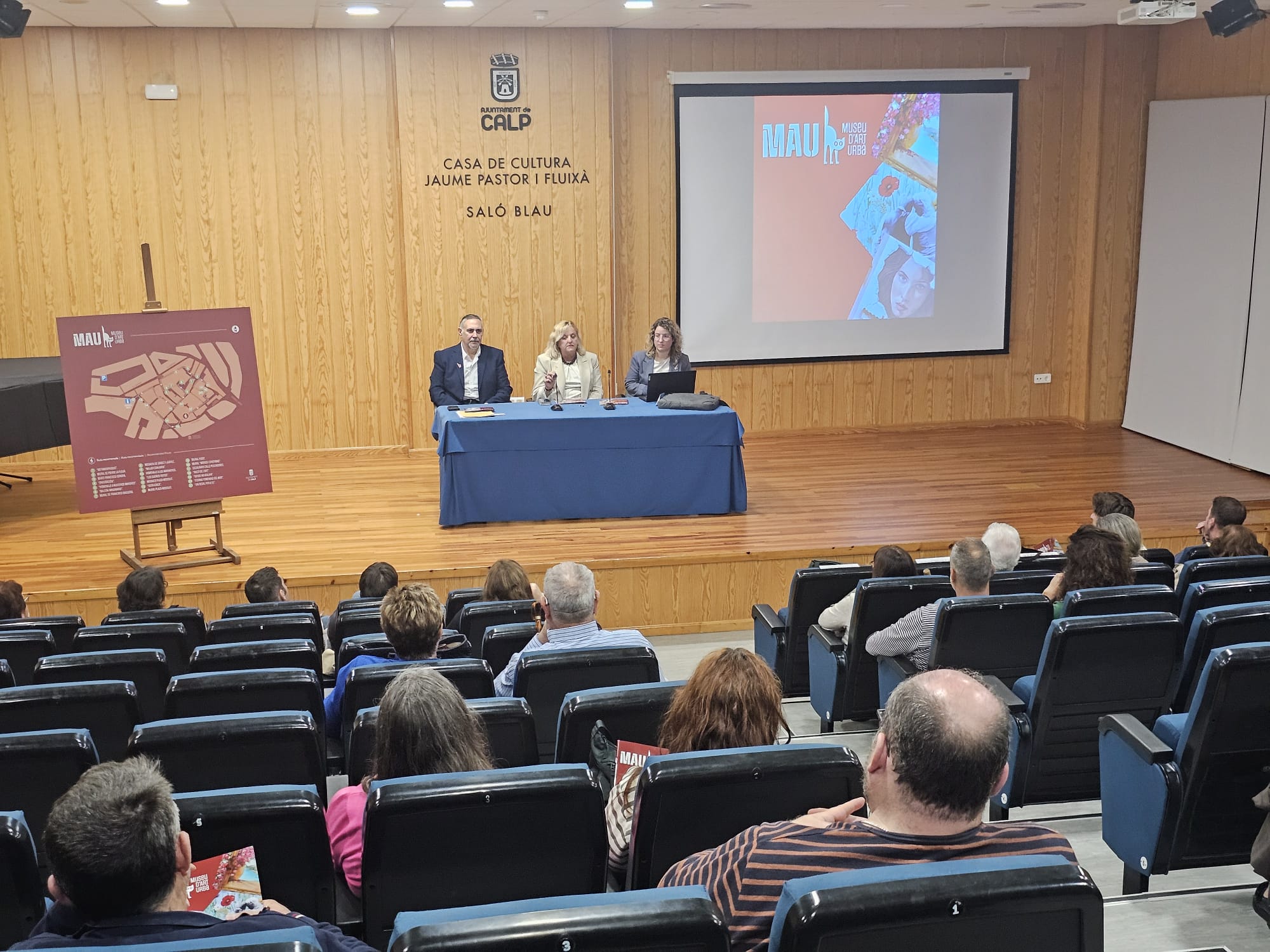
The Calp City Council, through its Departments of Culture and the Old Town, has launched the *Museu d’Art Urbà* (MAU)—a new cultural project that transforms the town’s historic center into an open-air museum.
Calp Mayor Ana Sala, joined by Guillermo Sendra (Councilor for the Old Town and Culture) and Mireia Ripoll (Councilor for Tourism Planning), unveiled the initiative. The project aims to establish this open-air museum as a national benchmark for cultural spaces of this kind.
The MAU comprises 21 artistic works—including mosaics, sculptures, and murals—distributed throughout the streets and small squares of the old town. A key, unique feature is the coexistence of contemporary creations alongside pieces over half a century old, all crafted by renowned artists.
Notable works include a 1966 mosaic by painter Gastón Castelló, located at the tourist office in Plaza Mosquit; murals by Gerda Pasteur (on Calle Puríssima) and Fernando Baquero (on Calle Vicente Gallart), both dating from 1988; and a piece by Pierre Le Fleur (1989) situated at the intersection of Calle Santísimo Cristo and Calle Reverendo Penalva, opposite the *Torreó de la Peça* (a historic defensive tower). Also featured are works by Elías Úrbez—recently named an "adopted son" of Calp—which can be found at various locations throughout the historic center.
As Guillermo Sendra explained, beyond their aesthetic and artistic merit, these works are significant for their deep connection to the history, traditions, and identity of Calp. Examples include the mural in Plaza Manuel Miró, in which Elías Úrbez pays tribute to Calp’s *Moros y Cristianos* (Moors and Christians) festival; the sculpture *Los sueños rotos* ("Broken Dreams") by Luciano González, which symbolizes the tragedy of migrants who risk or lose their lives at sea in search of a better future; and the mosaic *Homenaje a los marineros de Calp* ("Tribute to the Sailors of Calp"), dedicated to the town’s fishermen.
The museum is conceived as an open project, allowing for the future addition of new artistic creations. In fact, the collection of works in the old town has expanded in recent years with new installations that enrich the cultural heritage of this urban space.
To facilitate visits to the various works, a route has been designed, starting from what was previously the *Museo del Coleccionismo* (Museum of Collecting), which is being repurposed as the interpretation center for the MAU (*Museu d’Art Urbà* – Urban Art Museum). This center will allow visitors to learn about each piece in this open-air museum firsthand—a particularly useful feature during inclement weather that might otherwise hinder a walking tour.
The route will feature information plaques designed with universal accessibility in mind, incorporating NaviLens codes—a technology that provides easier access to information for individuals with visual impairments. Using a mobile app, users can detect these codes and listen to the content of the plaques via an audio narration, without needing to get close to them or point their phone’s camera directly at them. Furthermore, this system will function as an audio guide for all visitors, ensuring a more accessible and inclusive experience.
The MAU will also have its own distinct visual identity, centered on the figure of a cat with its fur standing on end; this creates a visual play on the acronym "MAU" (*Museu d’Art Urbà*) and serves as a key identifier for the project.
The goal of this project is to highlight the artistic and cultural heritage of the historic center, while also promoting the preservation of these works. In this regard, the murals at the Pòsit—including works by Gerda Pasteur and Fernando Baquero on Vicente Gallart Street—have been restored in recent years. Plans are also in place to soon begin restoration on the mosaic by Gastón Castelló, as well as the mural created by Pierre Le Fleur opposite the Torreó de la Peça.
Mireia Ripoll noted that the creation of the MAU also stems from the interest these works spark among visitors to Calp. She explained that the tourist offices frequently receive inquiries from visitors seeking information about the artistic features found in the historic center. Consequently, the new museum will provide more comprehensive and structured information about this heritage, while also adding a new asset to the municipality’s cultural and tourism offerings.