

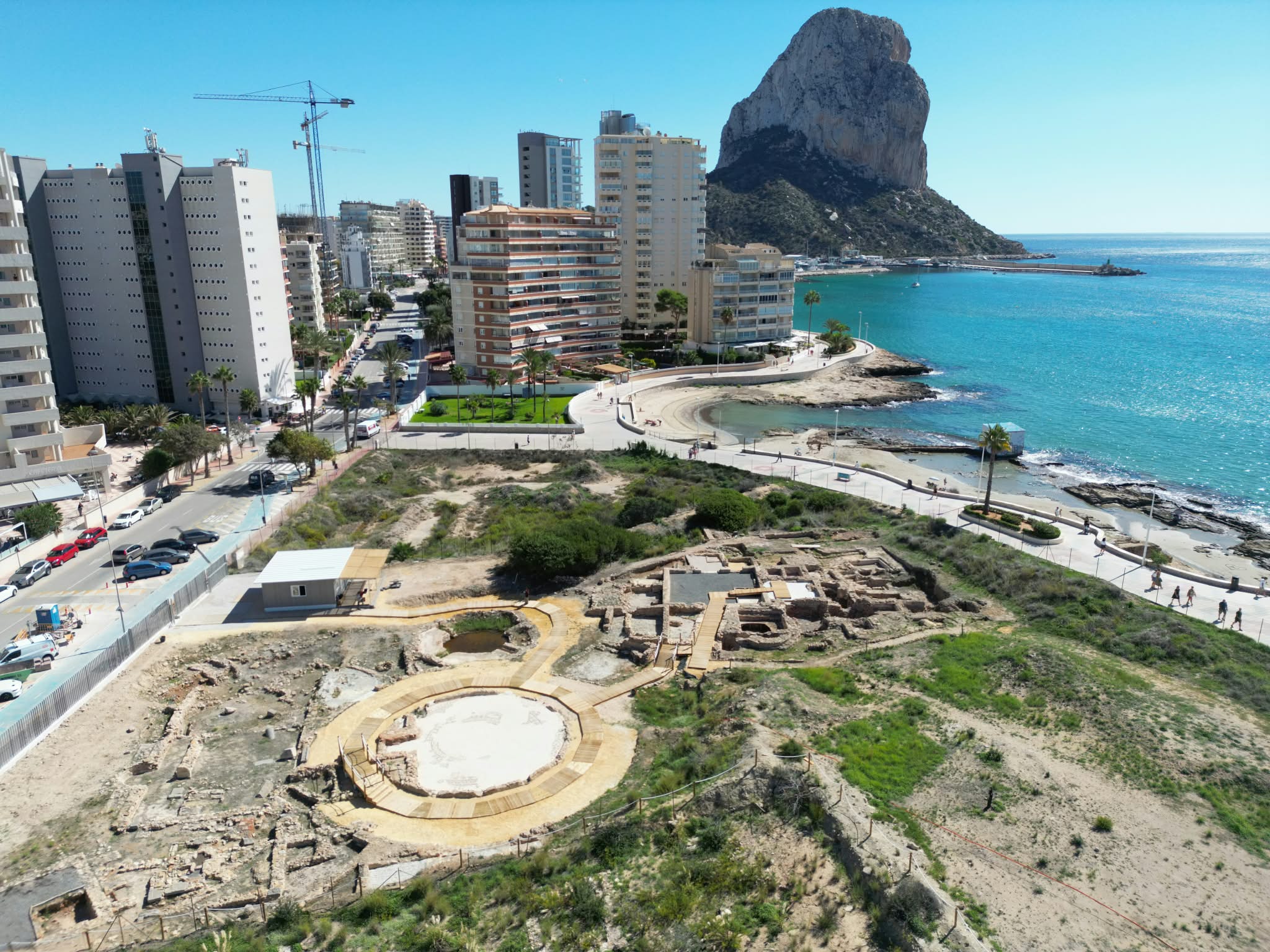
The Baños de la Reina Roman archaeological site in Calp has successfully completed its first year of regular public access, establishing itself as a major heritage and tourism landmark for the municipality. Since daily guided tours began on September 13 of last year, a total of 4,877 people have visited the site, restoring an archaeological enclave of immense historical value to the local heritage landscape.
The Department of Culture has reviewed this first anniversary, expressing great satisfaction with the public's response. Of the total visits, 3,610 were made by domestic tourists—primarily from the Valencian Community, followed by Madrid, Castilla-La Mancha, the Basque Country, and Catalonia. Internationally, the site attracted 1,267 foreign visitors, a group led by citizens from France, Belgium, the United Kingdom, and Germany.
Beyond its appeal as a tourist destination, the site has played a significant educational and social role. Over the past twelve months, it has welcomed school groups from Calp and neighboring towns such as Altea, Jávea, and La Nucía, as well as local organizations for seniors and groups involved in social services, education, culture, and sports. Additionally, groups from across Spain have visited the site, including the University of Alicante and associations from Fontilles, Alicante, Salamanca, Tarragona, and Cocentaina.
This cultural impact has also garnered media attention, notably a dedicated feature broadcast by the À Punt program *Via Verda*. Guillermo Sendra, the Councilor for Culture, highlighted that regular public access has demonstrated that tourists "also seek to learn about our history and heritage, thereby diversifying the municipality's offerings." For her part, the Mayor of Calp, Ana Sala, stated that "the cleaning, renovation, stabilization, digitization, and conversion into a museum site of the *Baños de la Reina*—along with their definitive opening to the public—represent one of this term's major achievements, fulfilling the long-standing goal of restoring this archaeological treasure and making it accessible to both residents and visitors."
The *Banys de la Reina* archaeological site, considered one of the most significant Roman complexes in Mediterranean Hispania, opened a year ago following the completion of museum-development works funded by the Alicante Provincial Council with an investment of €439,388.69.
The contract for free guided tours—offered from Wednesday to Sunday in Spanish, Valencian, and English—was awarded to ESATUR XXI SLU, a company specializing in the tourism management of archaeological sites that already operates at locations such as *Illeta dels Banyets* in El Campello and *Lucentum* in Alicante.
Also noteworthy is the mural "Vita in domus" by artist Begoña Movellán, which greets visitors and enriches the visual interpretation of the site.